

The Best Sourdough Hot Cross Buns Recipe
This post may contain affiliate links. Please read our disclosure policy.
Hot cross buns are a treat you look forward to every Good Friday. This sourdough version uses a starter instead of commercial yeast, so you get soft, fluffy buns with extra flavor. If you’ve made Sourdough Brioche before, the dough will feel familiar. It’s enriched, slightly pillowy, and satisfying to knead and shape. Raisins, orange zest, and warm spices fill your kitchen while they bake, and the apricot glaze on top makes them shiny and impossible to resist. You can bake them the same day or prep them the night before, and they’re perfect for Easter brunch or a Good Friday breakfast.

MY LATEST VIDEO
Why You’ll Love This Recipe:
- Tall and Fluffy with Great Texture-These sourdough buns come out tall, fluffy, and light, the kind of soft you get from properly prepped, enriched dough. The inside is soft and tender, and they have just enough chew to feel substantial without being dense. If you love that kind of texture, you’ll want to check out these Sourdough Discard Cinnamon Rolls too.
- Flavorful-The raisins, warm spices, and apricot glaze give these lightly sweet buns a lot of flavor for something so simple to put together. The sourdough starter adds a subtle tang that works really well with the sweetness of the raisins and glaze. If you already make Sourdough Cinnamon Rolls, you are going to love these too.
- Easy to Make-Sourdough Hot Cross Buns are not only delicious but easy to make, and you have two scheduling options to choose from. You can bake them start to finish in one day, or spread the work across two days. Both schedules are laid out below. In terms of complexity and time needed, they’re similar to Sourdough Sticky Buns.
Ingredients & Substitutions
* To find precise measurements, scroll to the bottom of this post to find the recipe card*
- Milk – I used whole milk here, but feel free to swap in other kinds, like almond, oat, or soy milk.
- Butter – I like using unsalted butter because it gives you more control, but if you’re using salted, cut the salt by 1/4 teaspoon.
- Flour-You’ll want a high-protein flour. I used King Arthur Bread Flour.
- Sugar – Adds a slight sweetness to the dough.
- Salt-You can use any unrefined salt, but I usually go with Redmond’s Unrefined Salt for the extra minerals.
- Sourdough Starter –You want your starter active and bubbly for this one. It does the heavy lifting in place of commercial yeast like instant yeast or active dry yeast.
- Egg – Adding an egg to this enriched dough makes it so light and fluffy.
- Vanilla – For the best flavor, use vanilla extract over imitation.
- Raisins – Plump raisins add both flavor and a little chew to these sourdough hot cross buns.
- Orange Zest –Freshly grated orange peel adds a bright, fresh flavor that plays really nice with the warm spices.
- Spices – These hot cross buns get their warm flavor from cinnamon, allspice, and nutmeg. You can swap in Pumpkin Pie Spice if you like.
Glaze
- Apricot jam-This jam adds sweetness and flavor to the buns.
- Water-Used to loosen the jam so it spreads easily.
Cross
- Water-Mixed with flour to make the pipeable paste for the cross.
- Flour-Creates the paste that forms the classic cross on each bun.
Same-Day Sourdough Hot Cross Bun Recipe
|
Time |
Process |
|---|---|
|
9:00 AM |
Make the Dough |
|
10:00 AM |
Knead |
|
10:15 AM |
First Rise |
|
3:15 pm |
Shape |
|
3:30 PM |
Second Rise |
|
6:30 PM |
Bake |
Two-Day Recipe
|
Time |
Process |
|---|---|
|
5:00 PM |
Make the Dough |
|
5:30 PM |
Knead |
|
5:45 PM |
First Rise |
|
9:45 PM |
Shape |
|
10:00 PM |
Place in the fridge |
NEXT DAY |
|
|
1:00 PM |
Second Rise |
|
5:00 PM |
Bake |
How to Make Sourdough Hot Cross Buns
Make the Dough
- Heat the butter and milk in a small saucepan on the stove or in a small bowl in the microwave until warm, but no hotter than 110°F. If the milk and butter mixture is too hot, it can kill the sourdough starter. I like to heat and then cool slightly before adding to the dough.
- Meanwhile, add the bubbly sourdough starter, egg, and sugar to the bowl of a stand mixer with a paddle attachment. Mix on low speed until combined, then gradually add the warm milk and melted butter.
- Add the flour and salt to the wet ingredients and mix again on low speed. Stop to scrape the sides of the bowl to incorporate all the dry ingredients, and then continue to mix on low for 1-2 minutes.
- The dough will look thick and sticky, like a cake batter. Cover with plastic wrap, a tea towel, or a shower cap (this is what I use) and allow the dough to rest for 30 minutes. This allows the gluten to rest before kneading.
Knead
- While the dough is resting, pour 1 cup of boiling water over the raisins and allow them to soak in a small bowl. This helps them soften and plump up. After soaking, drain the raisins, pat dry, and chop them into small pieces.
- After 30 minutes, remove the cover of the dough and add the raisins, orange zest, and warm spices. Knead the dough with the dough hook attachment for 10 -15 minutes at medium speed.
- You’ll know the bread dough has been kneaded completely when it is smooth and shiny. The dough will completely pull away from the sides of the bowl when it is being kneaded, and it will pass the windowpane test.
- This means when you stretch a small section of dough into a thin film, the light will be able to pass through without the dough tearing. If it does, the dough has been properly kneaded.
- Remove the dough and place it in a lightly greased bowl. The dough shouldn’t be overly sticky, just slightly tacky to the touch. I like to use butter. Cover it again.
Bulk Fermentation
- Place the dough in a warm place in your kitchen. That warm spot may be on top of your refrigerator, in a cabinet, or in the oven with the light on. The first proof should last about 5-8 hours. The bulk fermentation time greatly depends on the temperature of your kitchen. If you have a cold kitchen, like mine, the rise time will take longer. If your kitchen runs warm, the first rise will take less time. Bulk ferment the dough until it has at least doubled in size.
Shape
- Once the dough has doubled in size, punch it down to release the air bubbles. Then, place the dough on a lightly floured work surface.
- Gently stretch the dough into a large rectangle. With a bench knife or serrated knife, cut the dough into 15 equal pieces. You can weigh them for consistency; each should be about 90g or so, or eyeball it and call it a day.
- Pull the corners of the dough towards the center, flip, and then roll each piece of dough into a round, smooth ball. Repeat until all the balls are shaped.
- Lightly grease a 9×13 baking dish, round pan, or cast iron skillet. Place the shaped rolls into the baking dish, cover them with a damp tea towel, and let the dough rest for its second rise in a warm space. The final rise can take about 2-3 hours.
- If you’re not ready to bake the hot cross buns, cover the baking dish with plastic wrap and place it in the fridge for up to 24 hours. When ready, pull the rolls out of the fridge and continue to the second rise. Since the dough is cold from the fridge, the second rise time will take longer.
- You’ll know the final proof is complete when the dough balls have grown in size and look puffy.


Bake
- Preheat the oven to 350°F.
- No need for an egg wash here. Each bun gets brushed with apricot glaze right after it comes out of the oven.
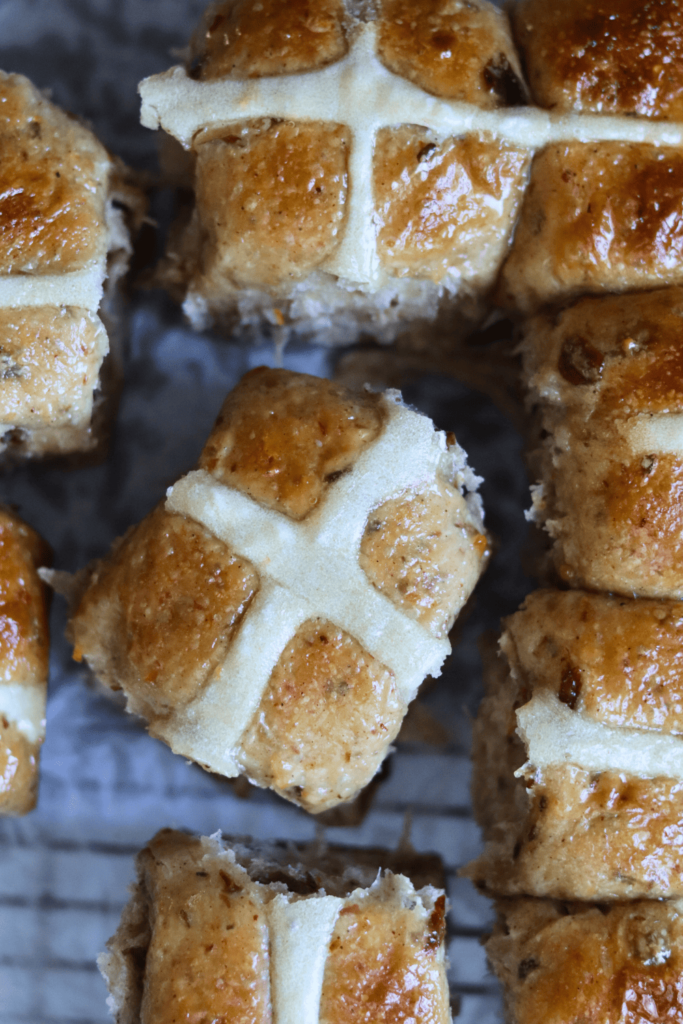
- For the iconic look of traditional hot cross buns, top each bun with a flour paste.
- In a small bowl, mix the water and flour. You could also use sourdough discard instead. You want the paste to be pipeable, but not runny. Pour the paste into a piping bag or ziplock bag with the corner cut. Slowly pipe the flour mixture on top of each bun to create the simple cross pattern.
- Bake for 30-35 minutes or until the rolls are golden brown. Fully baked rolls will have an internal temperature of 190°F.

Glaze
- While the buns are in the oven, go ahead and make the apricot glaze. In a small bowl, mix the apricot jam and some hot water. Set aside.
- Remove the rolls from the oven.
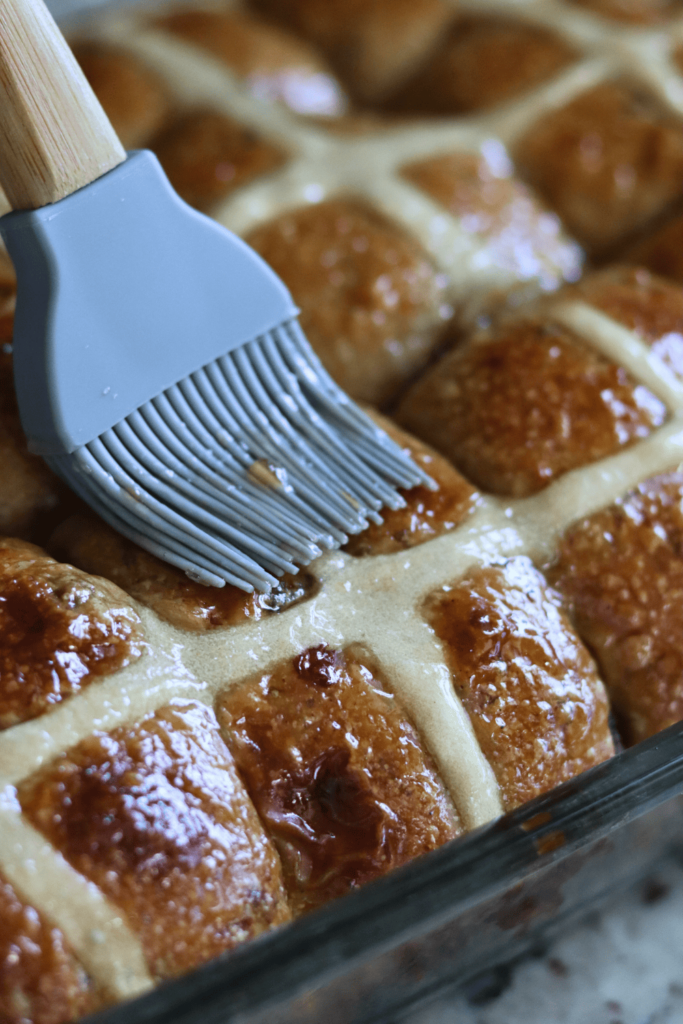
- Using a pastry brush, brush the top of the buns with the apricot glaze.
- Serve warm with a pat of butter or some more apricot jam.

McKenna’s Helpful Tips
- Don’t skip soaking the raisins. Pouring boiling water over them before kneading helps them soften and plump up. Pat them dry before adding to the dough so you don’t add extra moisture.
- Watch your milk and butter temperature. It should be warm but no hotter than 110°F. Too hot and it will kill the sourdough starter before the dough even comes together.
- Use the windowpane test to know when kneading is done. Stretch a small piece of dough into a thin film. If light passes through without tearing, it’s ready. If it tears, keep kneading.
- Find a consistently warm spot for your bulk fermentation. The first rise takes 5-8 hours, depending on your kitchen temperature. Use the top of the refrigerator, a cabinet, or the oven with the light on all work.
How to Store
Leftover Sourdough Hot Cross Buns will last 3-4 days when kept in an airtight container or Ziplock bag. They also freeze really well. Allow the buns to come to room temperature before placing them into a freezer bag. Remove all the air and seal the bag, then date and store them in the freezer for 2-3 months. Thaw on the counter until room temperature and enjoy.
FAQs
Yes, thanks to the two-day schedule built right into this recipe. Make and shape the dough the evening before, then place the baking dish in the fridge overnight. The next day, pull it out, let the buns complete their second rise, and bake. Since the dough comes out cold, the second rise will take a little longer than usual.
You can swap AP flour in at a 1:1 ratio. Use one with a protein content of around 11%. The higher the protein content, the better the rise.
Absolutely. Currants, cranberries, and dried apricots all work well here as a straight swap for the raisins.
The buns should be golden brown on top after 30-35 minutes in the oven. Fully baked buns will have an internal temperature of 190°F.



Sourdough Hot Cross Buns Recipe
Enter your email below, and we’ll send it straight to your inbox! Plus, you’ll get my newest sourdough recipes and best tips every week!
Ingredients
- 57 grams unsalted butter 4 Tablespoons
- 240 grams milk 1 cup
- 200 grams active sourdough starter 1 cup
- 100 grams sugar 1/2 cup
- 1 large egg room temperature
- 525 grams bread flour 3 3/4 cups
- 6 grams salt 1 teaspoon
- zest of 1 orange
- 150 grams raisins 1 cup
- 8 grams vanilla extract 2 teaspoons
- 3 grams ground cinnamon 1 1/2 teaspoons
- 2 grams allspice 1/2 teaspoon
- 1 gram nutmeg 1/4 teaspoon
Cross
- 70 grams all-purpose flour 1/2 cup
- 90-120 grams water 6-8 Tablespoons
Glaze
- 1/4 cup apricot jam
- Splash of boiling water
Instructions
MAKE THE DOUGH:
- Heat the butter and milk in a small saucepan on the stove or in a small bowl in the microwave until warm, but no hotter than 110 degrees F. If the liquid is too hot, it can kill the sourdough starter.240 grams milk, 57 grams unsalted butter
- Meanwhile, add the bubbly sourdough starter, egg, and sugar to the bowl of a stand mixer with a paddle attachment. Mix on low speed until combined, then gradually add the warm milk and melted butter.200 grams active sourdough starter, 100 grams sugar, 1 large egg
- To the wet ingredients, add the bread flour and salt and mix again on low speed. Stop to scrape the sides of the bowl to incorporate all the dry ingredients and then continue to mix on low for 1-2 minutes.525 grams bread flour, 6 grams salt
- The dough will look thick and sticky, like a cake batter. Cover with plastic wrap or a damp tea towel, and allow the dough to rest for 30 minutes. This allows the gluten to rest before kneading.You can also mix and knead this dough by hand.
KNEAD:
- While the dough is resting, pour 240 grams (1 cup) of boiling water over the raisins and allow them to soak in a small bowl for about 10 minutes. This will help them to soften and plump up.
- After soaking, drain the raisins, pat dry, and chop them into small pieces. Set aside.
- After 30 minutes, remove the cover of the dough and add the raisins, orange zest, vanilla extract, cinnamon, allspice, and nutmeg. Knead the dough with the dough hook attachment for 10 – 15 minutes at medium speed.You’ll know the bread dough has been kneaded completely when it is smooth and shiny. The dough will completely pull away from the sides of the bowl when it is being kneaded, is not sticky, but tacky to the touch, and it will pass the windowpane test.zest of 1 orange, 150 grams raisins, 8 grams vanilla extract, 3 grams ground cinnamon, 2 grams allspice, 1 gram nutmeg
- Remove the dough and place it in a lightly greased straight-edge bowl. Cover and leave in a warm place to double in size. I love using my straight-edge bowl because it allows me to clearly see when the dough has doubled in size.
BULK FERMENTATION:
- In my 70 degrees F kitchen, the first rise took about 5-8 hours. The bulk fermentation time greatly depends on the temperature of your kitchen. If you have a colder kitchen, like mine, the rise time will take longer. If your kitchen runs warm, the first rise will take less time. Bulk ferment the dough until it has at least doubled in size.
SHAPE:
- Once the Sourdough Hot Cross Bun dough has doubled in size, punch the top of the dough to remove all the air bubbles. Then, place the dough on a clean work surface.
- Gently stretch the dough into a large rectangular shape. With a bench knife or serrated knife, cut the dough into 15 equal pieces. You can weigh them for consistency, each should be about 90g or so, or eyeball it and call it a day.
- Pull the corners of the dough towards the center, flip, and then roll each piece of dough into a round, smooth ball. Repeat until all the rolls are shaped.
- Lightly grease a 9×13 baking dish, round pan, or cast iron skillet. Place the shaped rolls into the baking dish, cover them with plastic wrap, and let the dough rest for its second rise.In my 70 degree F kitchen, the second rise took about 2-3 hours.
- If you're not ready to bake the hot cross buns, cover the baking dish with plastic wrap and place it in the fridge for up to 24 hours. When ready, pull the rolls out of the fridge and continue to the second rise. Since the dough is cold from the fridge, the second rise time will take longer.
- You will know the final proof is complete when the dough balls have grown in size and look puffy.
BAKE:
- Preheat the oven to 350 degrees F.
- No need for an egg wash for these Sourdough Hot Cross Buns! Each bun will be topped with a delicious apricot glaze after they are baked!
- For the iconic look of traditional hot cross buns, we will top each bun with a flour paste.
- In a small bowl, mix the water and flour. You could also use sourdough discard, instead! You want the paste to be pipeable, but not runny. Pour the paste into a piping bag or ziplock bag with the corner cut. Slowly pipe the flour mixture on top of each bun to create the simple cross pattern.70 grams all-purpose flour, 90-120 grams water
- Bake for 30-35 minutes or until the rolls are golden brown. Completely cooked rolls will have an internal temperature is 190 degrees F.
- While the Sourdough Hot Cross Buns are baking, prepare the apricot glaze. In a small bowl, mix the apricot jam and some hot water. Set aside.1/4 cup apricot jam, Splash of boiling water
- Remove the rolls from the oven. Using a pastry brush, brush the top of the buns with the apricot glaze.
- Serve warm with a pat of butter or more apricot jam!

This are incredible delicious and so easy to make withbyour recipe and explanation. Thank you so.much for sharing.
I’m so thrilled to hear that you loved this recipe! We can’t get over how fluffy and flavorful they are! Thank you for taking the time to leave such a kind comment.
What should the dough look like after the bulk fermentation after the first rise? It says you should punch it down which makes me think it should be dull and lofty. Mine is still shiny and larger (not sure if double) but not aerated. Did I do something wrong?
That actually sounds pretty normal for this dough! It won’t look dull and lofty like a basic sourdough loaf. If it’s larger and feels a bit lighter, you’re likely in good shape. The biggest rise usually happens during the second proof.