

Easy Roasted Garlic and Rosemary Sourdough Bread Recipe
This post may contain affiliate links. Please read our disclosure policy.
My easy sourdough bread recipe just got a savory upgrade. With roasted garlic, fresh rosemary, and cubes of Asiago cheese, this loaf fills your kitchen with an irresistible aroma and brings bold, herb-and-cheese flavor to your sourdough. It’s perfect toasted alongside soups and stews, sliced thick for grilled cheese, or even enjoyed on its own. Leftovers stay fresh for a few days at room temperature, or you can freeze slices and toast them anytime for a quick, flavorful bite without starting a whole loaf from scratch.

MY LATEST VIDEO
Why You’ll Love This Recipe
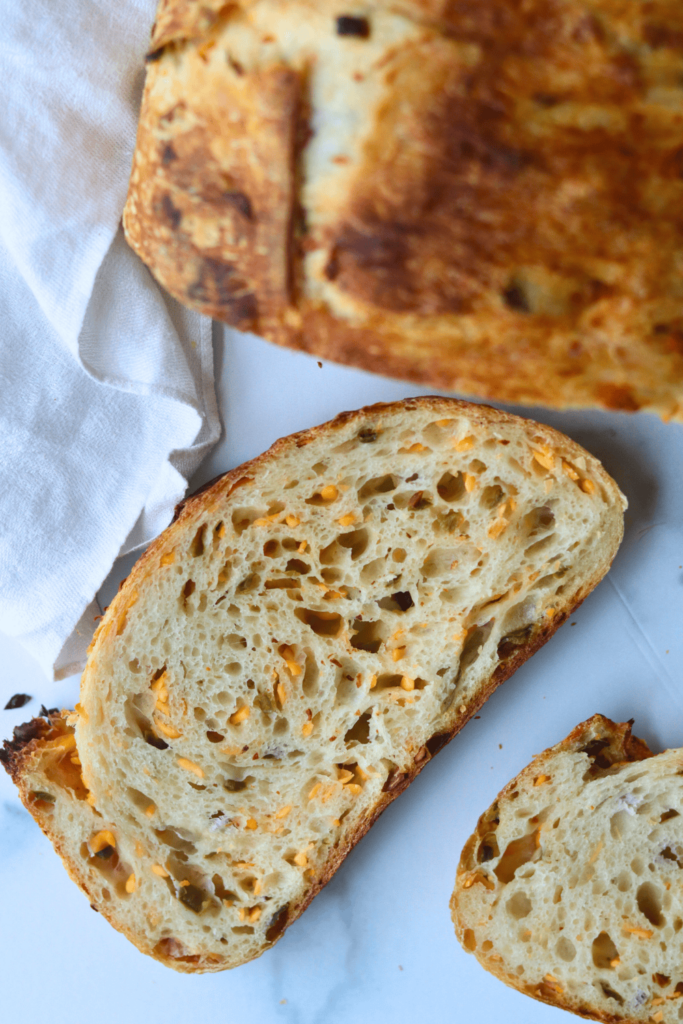
- Roasted Garlic Adds Deep, Sweet Flavor–The garlic is roasted until soft and golden, transforming its sharp bite into a mellow, rich flavor that infuses the homemade loaf. Each slice carries that fragrant, slightly sweet garlic aroma that fills your kitchen and makes your sandwiches, soups, or grilled cheese feel even more flavorful. This method of incorporating bold, flavorful mix-ins is similar to how my Jalapeño Cheddar Sourdough Bread packs punch with diced jalapeños and cubes of cheddar folded throughout the dough.
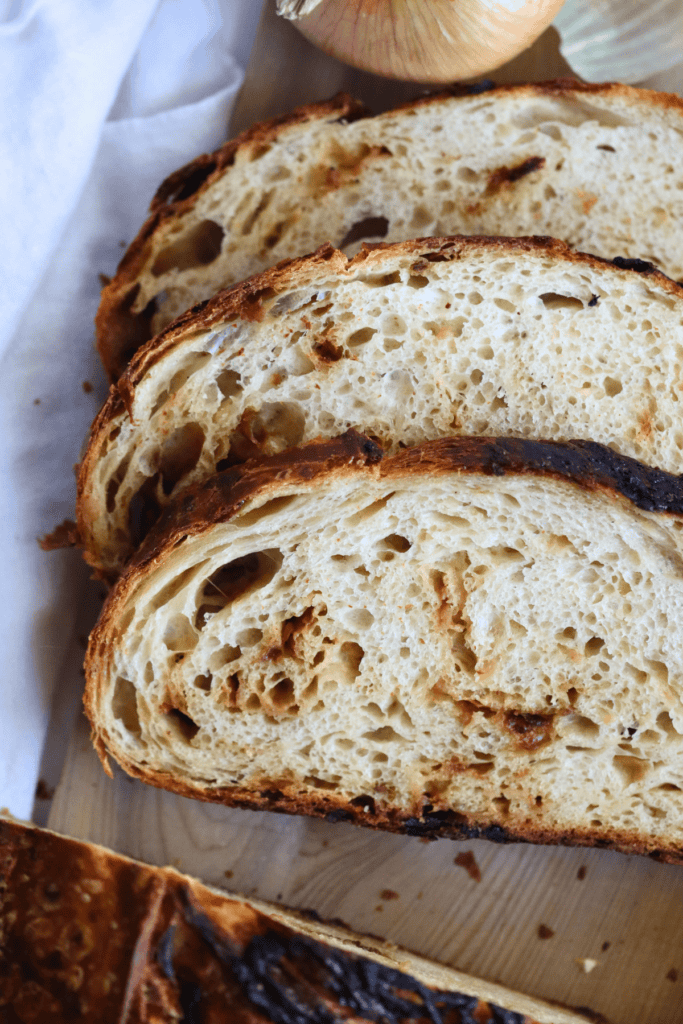
- Flavor Boost from Fresh Rosemary and Cubed Cheese–Fresh rosemary adds a bright, fragrant aroma that goes perfectly with cubes of Asiago or Gruyere. As the cheese melts into the dough, it forms little pockets of creamy, savory flavor while the crust stays nice and crunchy. If you like that mix of sweet, savory, and aromatic flavors, the Cinnamon Raisin Sourdough Bread offers a sweet and spiced contrast you’ll want to try next.
- Overnight Fermentation – The dough ferments overnight, giving the sourdough starter plenty of time to develop a tender, airy crumb. That same long fermentation is what makes the Honey Oat Sourdough Bread so soft and flavorful, adding depth to your loaf without any extra effort.
Ingredients & Substitution
* To find precise measurements, scroll to the bottom of this post to find the recipe card*
- Active, bubbly starter: Before baking this cheesy rosemary garlic sourdough bread, you need to feed your own sourdough starter with equal parts water and flour. When your starter has doubled in size and has bubbles on top and throughout (usually 4-12 hours after a feeding), it’s ready to bake. If you’re still unsure, use the float test. Take a spoonful of your starter and a glass of water. Drop the starter in the water. If it floats, it’s ready. If it sinks, it needs some extra time to ferment.
- Room temperature water-Filtered or tap water works fine, just make sure it’s not cold so it doesn’t slow down the starter
- Bread Flour: My favorite brand is King Arthur Bread Flour. I use bread flour for its higher protein content.
- Salt: Any salt will work for this sourdough loaf, but I like Redmond’s Unrefined Fine Sea Salt for the extra minerals it offers.
- Fresh garlic – Roasted garlic gives this sourdough bread a mellow, rich flavor without overpowering the loaf. Roasting fresh garlic will give you the best flavor. If you’re in a pinch, you can swap 1 Tablespoon of garlic powder as a replacement.
- Fresh Rosemary: Fresh rosemary – Pick leaves off the stem and chop finely. To prep fresh rosemary, hold the top of the stem with one hand and drag your fingers down the stem to remove the leaves. Then chop them finely with a sharp knife. If fresh rosemary isn’t available, 1 Tablespoon of dried rosemary works as a substitute. You can also experiment with other fresh herbs and see how you like them.
- Cheese: Cubed for pockets of creamy, melty flavor throughout the bread. It’s not absolutely necessary to add cheese to this garlic sourdough bread recipe, but come on, you know you want to. I cut into cubes so the cheese distributes evenly and melts in pockets throughout the bread. These mild cheeses complement the garlic and rosemary, and cubed pieces spread more evenly than shredded.
- Extra virgin olive oil: Used for roasting the garlic.
How to Make Roasted Garlic and Rosemary Sourdough Bread:
Roast Garlic in the Oven
- Preheat the oven to 400°F.
- Peel off the papery layer of the garlic head while keeping the cloves intact.
- Cut a piece of aluminum foil big enough to wrap around the garlic.
- Chop off about 1/4 inch from the top of the garlic head.
- Place the garlic in the center of the foil and pour extra virgin olive oil on top, about 1 Tablespoon. Cover the garlic with the foil and place it in the preheated oven.
- Roast for 30–40 minutes, or until the garlic is golden brown and fragrant.
- Remove from the oven and let it cool for 5–10 minutes before adding to the bread dough.
Make the Dough

- In a large mixing bowl, add 50g of active, bubbly sourdough starter and 350g of room-temperature, filtered water. Mix with a dough whisk or your hand until it looks like a milky liquid.

- Add 500g of bread flour and 11g of salt. Mix until all the flour is incorporated. The dough will look shaggy, not like a uniform dough ball. Cover the bowl with a damp tea towel (or a reusable shower cap) and let the dough rest for at least 30 minutes before moving on.
Stretch and Folds
- With slightly wet fingers, scrape the dough away from the bowl. Grab a section of the dough, stretch it above the bowl, and fold it over on top.
- Rotate the bowl a quarter turn clockwise and repeat. Continue until you’ve gone all the way around. The dough will start to look smoother.
- Cover the dough and let it rest for another 30 minutes.
Mix-Ins
- Before the second round of stretch and folds, gather 1 Tablespoon of finely chopped rosemary, 1 head of roasted garlic, and 1 cup of cubed cheese.

- Sprinkle 1/3 of each mix-in on top of the dough. Do a stretch and fold. Repeat with another 1/3, then the last 1/3. Some cubes may break through the dough – that’s fine. They’ll continue mixing in during the next rounds. Cover and rest for 30 minutes.

- Repeat the stretch and fold three more times (for a total of five rounds), waiting at least 30 minutes between each. Cover the dough with a damp tea towel or shower cap after each round.

Bulk Fermentation
- After all 5 rounds of stretch and folds, cover the dough with a damp towel or shower cap and leave it on your countertop to rise overnight 10–12 hours.
- During this first rise, the sourdough starter ferments the flour, creating air pockets for that desirable crumb.
Shape
- The next day, the dough should have doubled in size and not look dense.
- With slightly wet fingers, gently release the dough from the sides of the bowl. Be careful not to pop the bubbles.
- Tilt the bowl and let gravity move the dough onto your work surface.

- Stretch the dough into a thin rectangle.

- Fold the top 1/3 toward the center, then fold the bottom 1/3 toward the center as well (a tri-fold).

- From the right side, roll the dough to the left to create a ball.

- Let it rest 5–10 minutes with the seam side down.
- While the dough rests, prepare your proofing basket (banneton or small bowl lined with a tea towel). Dust the banneton with flour so the dough doesn’t stick. You can use rice flour or a mix of rice and all-purpose flour/bread flour.] Don’t have a Dutch oven or banneton? No problem! You can also bake this Sourdough Bread in a Loaf Pan!
- After resting, gently cup your hands around the dough ball. Turn it clockwise about a quarter turn, softly pull the dough toward you, and repeat until it forms a tighter, round shape. Carefully place the dough smooth-side down into the floured proofing basket. Cover with a damp tea towel or shower cap.
- Place the proofing basket in the fridge. Let the dough rise for at least 1 hour, ideally 8–12 hours. Don’t wait too long! Over-proofed dough won’t rise in the oven, but you can bake it as focaccia to salvage it.
Score
- After 8–12 hours, remove the dough from the fridge.
- Cut a piece of parchment paper big enough to hold the dough. Flip the banneton upside down over the parchment so the dough lands smooth-side up.
- Score a crescent moon or any design you like.
- Grab the corners of the parchment paper and place the dough in your Dutch oven.
Bake
- With the lid on, place your cold Dutch oven on a baking sheet (prevents the bottom from burning). Slide the tray and Dutch oven into the cold oven and preheat to 450°F. Bake for 55 minutes (this includes the preheat time).
- Remove the lid and bake 5 more minutes, or until golden brown.
- Immediately remove the Dutch oven and lift the bread using the parchment corners. Place it on a cooling rack.

Cool and Serve
- Let the bread cool for 1 hour before cutting. Listen to your loaf “sing” as it cools.
- After an hour, slice and slather on butter and enjoy. Serve thick slices of roasted garlic and rosemary sourdough with a big slab of butter. For extra garlic punch, make some garlic or garlic herb butter, garlic breath isn’t real, right? This bread turns into a killer grilled cheese, especially with melty cheese and a bowl of basil tomato soup. Have leftover slices? I turn mine into breadcrumbs, and the garlic and rosemary make them amazing in my mother-in-law’s meatballs.
McKenna’s Helpful Tips
- Don’t skip roasting the garlic – Roasting garlic transforms its sharp bite into soft, sweet, rich flavor that infuses every slice. Even if you’re short on time, a tablespoon of garlic powder works in a pinch, but the roasted version is worth it.
- Prep your rosemary right – Strip the leaves from the stem by holding the top and dragging your fingers down. Chop the leaves finely. Fresh rosemary adds a bright, fragrant note that pairs perfectly with the cheese and garlic. If fresh isn’t available, a tablespoon of dried rosemary is a good backup.
- Cube the cheese – Cubed cheese melts into little pockets, spreading flavor evenly through the dough. Mild cheeses like Asiago or Gruyere work best with garlic and rosemary. Cubes are easier to handle than shredded.
- Give your dough time to rest – Let it rest between stretch-and-fold sessions and after shaping. This relaxes the dough, makes it easier to work with, and helps it rise evenly for a light, airy crumb that holds all those garlic, rosemary, and cheese pockets.
- Flour the proofing basket – Dust your banneton or lined bowl with flour so the dough doesn’t stick. You can use rice flour or a mix of rice and all-purpose/bread flour.
How to Store
Garlic sourdough bread will stay fresh for 2-3 days at room temperature. Cover it with a tea towel and leave it on the counter. You can also freeze it, either as a whole loaf or as slices. I like to freeze slices so I can toast just what I need instead of thawing a whole loaf. To freeze, put the loaf or slices in a plastic bag, adding small pieces of parchment between slices so they don’t stick, and remove all extra air.
Frozen sourdough will keep for up to 3 months. To thaw, heat a whole loaf in the oven at 325°F for 20-30 minutes until soft in the middle. For slices, microwave them for 15 seconds or pop them in the toaster.

FAQs
Yes! If you don’t have Asiago or Gruyere, try mild cheddar, Fontina, or Havarti. If you love adding cheese to sourdough, then you’d love my Caramelized Onion & Gruyere Sourdough Bread recipe!
You can use 1 tablespoon of dried rosemary instead. Other fresh herbs like thyme or oregano can be used, but rosemary is what gives this loaf its distinct flavor.
Roasting really brings out a mellow, sweet flavor, but if you’re short on time, 1 tablespoon of garlic powder will still give a garlicky taste.
Your starter should be active and bubbly, usually 4–12 hours after feeding. If unsure, do the float test: drop a spoonful in water. If it floats, it’s ready. And if it sinks? Give it a little more time.


Roasted Garlic and Rosemary Sourdough Bread Recipe
Enter your email below, and we’ll send it straight to your inbox! Plus, you’ll get my newest sourdough recipes and best tips every week!
Ingredients
- 50 grams active sourdough starter 2 Tablespoons
- 350 grams water, room temperature scant 1 1/2 cups
- 500 grams bread flour 3 1/2 cups + 1 Tablespoon
- 10 grams salt 1 1/2 teaspoons
- 1 head of garlic
- 14 grams olive oil 1 Tablespoon
- 3 grams fresh rosemary, chopped finely 1 Tablespoon
- 175 grams Asiago / Gruyere cheese, 1/4 inch cubes or shredded (optional) 1 1/4 cups
Instructions
How to Roast Garlic in the Oven:
- Preheat the oven to 400 degrees F.
- Peel off the papery layer of the garlic bulb while keeping the cloves intact. Cut a piece of aluminum foil big enough to wrap around the garlic. Chop off 1/4 of an inch of the top of the garlic bulb.1 head of garlic
- Place the garlic in the center of the foil and pour extra virgin olive oil on top. Cover the head of garlic with the foil and place it into the preheated oven.14 grams olive oil
- Roast for about 30-40 minutes or until the garlic is golden brown and fragrant.
- Remove from the oven and cool for 5 – 10 minutes before adding to the bread dough.
How to Prepare Fresh Rosemary:
- To use fresh rosemary, gently remove the leaves from the stem. Do so by holding the top with one hand and dragging the fingers of your other hand down the stem. Once removed, chop the rosemary leaves finely.3 grams fresh rosemary, chopped finely
Make the Dough :
- In a straight edge bowl, add the active sourdough starter and room temperature water. Mix with a Danish dough whisk or your hand until it looks like a milky liquid.I love using this straight edge bowl because it allows me to clearly see when the dough has risen to 75%.50 grams active sourdough starter, 350 grams water, room temperature
- To the wet ingredients, add the bread flour and salt. Be sure to mix until all of the flour is incorporated. The dough will look shaggy, not like a uniform dough ball.500 grams bread flour, 10 grams salt
- Cover the bowl with the plastic cover or plastic wrap and let the dough rest for at least 30 minutes before you move on to the next step.
Stretch and Folds:
- With slightly wet fingers, scrap the dough away from the bowl. Grab a section of the dough and stretch the bread dough above your bowl. Then fold over on top of the dough.
- Rotate your bowl clockwise a quarter of the way and repeat identical stretch and fold. Repeat the process until you come full circle. You will notice the dough will start to look much smoother than before.
- Cover the dough again and let rest for another 30 minutes.
Mix-Ins :
- Before starting your second round of stretch and folds, prepare the mix ins. Squeeze the head of roasted garlic to remove the bulbs from the papery layer.
- To the top of your dough, sprinkle 1/3 of each mix-in. Perform a stretch and fold. Then add another 1/3 of the mix-ins, do one more stretch and fold. Add the last 1/3 of the mix-ins and complete the rest of the stretch and folds. Cover and let rest for another 30 minutes.175 grams Asiago / Gruyere cheese, 1/4 inch cubes or shredded (optional)
- The cubes of cheese may break through the dough, totally fine. They will continue to be mixed in during your next rounds of stretch and folds.
- Repeat the identical stretch and fold two more times (for a total of 4 different rounds), waiting at least 30 minutes between each stretch and fold. Cover the dough after each stretch and fold.
- Once you have completed the final set of stretch and folds, cover the dough and let it rest for the remainder of the bulk fermentation at room temperature, about 9-11 more hours if the dough is kept at 68-70 degrees F.
Bulk Fermentation
- Now this is the most finicky part of sourdough. There isn’t a set time for your bulk ferment. It is greatly dependent on the temperature of your environment. The warmer it is, the faster your dough will ferment. The opposite is true for cooler temperatures.
- In an environment of 68-70 degrees F, doughs will typically bulk ferment for 9-11 hours more after the stretch and folds, but again, you will have to look for the signs that your dough is done fermenting, rather than the clock. Warmer temperatures will be faster, while cooler temperatures will be slower.
Here’s what to look for:
- The dough should have increased in size by at least 75% and be domed on top.The dough looks light, and jiggles when the bowl is shaken.The dough should easily pull away from the bowl.There should be visible bubbles in the dough and on top.The dough doesn’t tear when you do a windowpane test
Pre-Shape
- Once your dough has completed its bulk fermentation, continue on to the pre-shape.
- With slightly wet fingers, gently release the dough from the sides of the bowl. Be careful not to pop all of those lovely bubbles! Tilt the bowl and leave gravity to do the work to move the dough on the counter.
- Shape the dough by doing another round of stretch and folds until you have gone full circle.
- With a bench scraper or your hands, turn the dough upside down, so the seam is now on the counter. Cover the dough with the bowl and let it rest for 30 minutes.
Prep Banneton :
- While you are waiting for the dough to rest, prepare your proofing basket. This can either be a banneton or a small mixing bowl lined with a tea towel. The purpose of this proofing basket is to keep the tight shape that you will create, so make sure you are using a standard bowl that is small enough to help keep the shape.
Final Shaping :
- After 30 minutes of rest, flip the dough, with the seamed side up. Gently pull the bottom of the dough towards you, then fold it towards the center of the dough. Pull the right side of the dough out and fold towards the center. Repeat with the left side. Finally, stretch the top of the dough away from you and fold towards the center of the dough.
- For a boule shape, flip the dough over again, seam side down.Gently cup your hands around the dough ball. Turn the ball in a clockwise motion about a quarter turn and then softly pull the dough towards you. Do this repeatedly until you see the dough form a tighter and more round shape. Stop if the dough starts to tear.
- With a bench scraper or just your hands, carefully scoop up the dough and lay it upside down (seem side up) into your floured proofing basket and cover it with a plastic bag or a shower cap.
- For a batard shape, roll up the dough starting with the dough closest to you. Once rolled, pinch the seams of each end close, then gently place the rolled up dough into the prepared banneton (seam side up). Cover it with plastic bag or a shower cap.
Cold Proof :
- Place your proofing basket in the fridge to cold-proof for 8-72 hours.Cold fermenting the dough in the fridge slows down the fermentation process, which enhances the flavor of your loaf. It also gives you more flexibility when you bake your bread.But don’t wait too long! If left in the fridge for too long, your dough will over-ferment, causing the dough to not be able to rise while baking.
Score :
- Thirty minutes before baking, place the dough in the freezer. This helps with the scoring design.
- Cut a piece of parchment paper that is big enough for your dough to be surrounded on the bottom and its edges.
- Place parchment paper on your workspace and gently flip the banneton upside down over the parchment paper. Since you dusted the banneton, your dough should slowly release and fall onto the parchment paper, landing in the middle with the floured side facing up.
- With a lame/ razor blade or sharp knife, score a crescent moon shape or any other fancy design you might find on Pinterest that you are dying to try! Grab the corners of the parchment paper and place it into your Dutch oven.
Bake:
**This recipe can be baked in a HOT Dutch oven, if you prefer. See Notes below for step-by-step directions.
- With its lid on, place your COLD Dutch oven on a baking sheet – this helps prevent the bottom of your loaf from burning and getting too crispy. Slide the baking tray and Dutch oven into the COLD oven and preheat it to 450 degrees. Bake for 55 minutes. The baking time includes the preheat time.
- After 55 minutes, remove the lid and bake for an additional 5-10 minutes, or until golden brown or the internal temperature reaches 205-210 degrees F.
- Immediately remove the Dutch oven from your oven. Using the corners of the parchment paper, lift the sourdough bread and place it onto a cooling rack to cool.
- Allow your homemade bread to cool for one hour before cutting into it. (I know!! How can you possibly wait when it looks and smells so good?! But trust me, if you cut in too soon, your masterpiece will turn mushy and gummy.) In the meantime, listen to your loaf "sing" its little tune to you with every crinkle and crack.
- Once the hour is up, slice into your work of art and slather on some butter, and ENJOY!
Notes
Bake in Preheated Oven
- Preheat the Dutch oven in a 500 degree F oven for 30 minutes.
- Reduce the oven temperature to 450 degrees F. Carefully place the dough into the hot Dutch oven, then bake the loaf for 27 minutes covered.
- Continue to bake for an additional 10-15 minutes uncovered until golden brown or the internal temperature reaches 205-210 degrees F.
Recipe Tips
- Substitute 1 Tablespoon of garlic powder for 1 head of roasted garlic.
- Substitute 1 Tablespoon of dried rosemary for fresh.
- Garlic Sourdough Bread will stay fresh for 2-3 days. Cover with a tea towel and leave at room temperature.
- Freeze loaf or slices in a plastic bag for up to 3 months.

Wow!! This bread is delicious and just what I was hoping for. Worth the wait, patience truly paid off. I will be sharing this recipe and definitely making this again. I doubled the rosemary and cheese. But all other directions were followed perfectly.
Thank you for sharing. If I could load a picture I would.
I’m so thrilled to hear that you loved it! The smell alone is worth baking it. Thank you for sharing!
Can I use just regular flour or artisan flour instead of the bread flour??
I recommend using bread flour instead of all-purpose flour because it has a higher protein content. This allows your bread to have the best rise when it is baked!
I’m planning to make two loaves at the same time. Would you recommend mixing and doing stretches & folds in separate bowls or do everything in one bowl and just spit the dough when it’s time to shape?
I would mix everything in the same bowl and split it in two before shaping. Less dirty dishes 🙂
This sounds amazing! Question- do you chop the garlic before adding it to the loaf, or are you adding entire cloves? Thanks!
I add the entire cloves! They will swish out after being roasted and start to break into small bits while you do your stretch and folds.
I am currently making this bread (I’m so excited) minus the rosemary (husband doesn’t like it). I’m ready for the first rise. I added cheese to the dough but I’m concerned about the cheese being left out on the counter for 10-12 hours. Is this safe? Also, your ingredient list calls for 10g of salt but the directions say 11g.
Oh, I hope you love it! It is such a tasty flavor combination. Thank you for catching my typo! It should be 10g of salt. As for the cheese, I haven’t had any issues, but if you feel more comfortable with the cheese not being left out on the counter that long, you can add the cubes after the bulk fermentation while you shape the dough. This method is called lamination. You’ll find plenty of tutorials of how to do this online 🙂
Ive made this loaf 3 times now. Currently making 2 more. It’s sooo good and rises beautifully. Thank you!!
Thank you so much for sharing your sourdough successes! I can totally understand, this loaf hits the spot every time. Enjoy!
Hello, I’m a little confused. Do we put the bread in with the cold dutch oven into the cold oven? I was always told to pre-heat the DO first. So, I just want to clarify. Also, thank you for this recipe. I doubled it because I’m making 2 loaves but oooh my it smells delicious. Can’t wait to bake.
No worries! But that is correct. Place the bread in the cold DO into the cold oven and bake! The bake time includes the preheat time, as well. You are so welcome! It is one of our favorite loaves to make, so I hope you enjoy 🙂
I had doubled this recipe so I did one loaf cold and one hot since it was right after. The cold came out with a beautiful golden crust. It was hard to wait an hour. It was delicious. I haven’t cut into the hot one since I’m gifting it to a friend. Thank you again!!!
Thank you so much for sharing! We love this sourdough recipe, so it warms my heart that it was enjoyed by your family and friends, as well.
Did you start with a cold oven and dutch oven or did you preheat both?
Hi Steve! Great question. The 55 minute bake time is including the preheat time. I pop the Dutch oven into my cold oven, set the temperature, and then set my timer to 55 minutes. Hope this helps!
Recipe says to put the bread in the oven, preheat to 450 degrees and bake for 55 min. Is the 55 min start when placed in oven or once the oven is preheated?
Hi Suzanne! Great question – the 55 minutes starts once you place the bread into the oven. Happy baking!
I have been wanting to branch out and try some new sourdough recipes and this looks incredible! Thank you for sharing!
That is so exciting! Sourdough is such a delicious hobby to have. If you have any questions, please reach out!
When you do the first bulk ferment do you put in fridge for the 10-12 hours or keep on kitchen counter at room temp?
The first bulk ferment is done on the counter at room temp. If your kitchen is warmer, the bulk fermentation will be faster. The opposite is true for a colder kitchen.
Is there a concern for potential over proofing by letting it rise overnight for the 10-12 hours?
Hello! Great question. This time suggestion is with a cooler environment in mind (65-68 degrees). Warmer temperatures will be have a shorter bulk fermentation, while cooler will be longer.
Hi!
I’m a newbie to sourdough bread making. And I’m very literal. When you say add the head of garlic, do I add it just as it came from the oven, with skins and base and all? Or do peel all that off and add the inside parts only? Do I do anything to the garlic (mash it or chop it up?)
Thanks for your help!
Renee
Hi Renee! Do not add the skins and base. Once the garlic has cooled slightly, squeeze out the roasted garlic into the dough. It will mix into the dough as you continue to do stretch and folds.
Not only does this bread look super delicious (ok, I love anything sourdough), your recipe is also very detailed. I’ll have to make this soon!
Thank you so much, Anja! My family couldn’t get enough when I made this bread for them. What is it about garlic, rosemary, and cheese that is just so heavenly? Please share with me your thoughts when you are able to make it!
This looks so good! I can’t wait to try – I know my husband would love this!
I hope you both love it 🙂
Hi, I had a question. I followed the recipe exactly and the crumb came out super gummy and didn’t rise. I didn’t cut into it when it was cold, but I feel like it lost a lot of rise in the cold bulk rise. I’m at a lost with the gummy texture.
It sounds like there might have been an issue with the fermentation process. If the dough was over proofed, it won’t rise while baking and have a gummy center. Next time, look for the signs that your dough is done fermenting, rather than the clock.
I’m a sucker for all things garlic, this sounds absolutely delicious! Thank you for sharing 🙂
If you love garlic, then this will be right up your alley! Enjoy 🙂
SO GOOD! Me and my husband love this bread!
So thrilled to hear that! Thank you for sharing!
This looks and sounds AMAZING! I’ll definitely have to give this recipe a try when I’m feeling brave with my sourdough skills! 🙂
Oh, I hope you do! It’s so simple to add extra flavorings to a sourdough loaf!
These flavors sound incredible! I can smell it already!
Yes!! It smells as good as it tastes 🙂
I roasted peeked garlic in the airfryer but followed the recipe otherwise. It turned out great! Thanks.
I’m so glad you enjoyed it! 🙂
I think this is the best loaf of sourdough that I have ever made…it came out beautifully.
I am so happy to hear! We absolutely love it. Glad it was enjoyed 🙂