

The Best Sourdough Sandwich Bread Recipe (Soft & Fluffy)
This post may contain affiliate links. Please read our disclosure policy.
This Sourdough Sandwich Bread is the kind of everyday loaf I make again and again because it’s incredibly soft, fluffy, and completely naturally leavened with 100% sourdough starter. It has that perfect balance of flavor and texture that works for everything from toast in the morning to sandwiches packed for lunch.
Even though it’s fully fermented, the dough is simple to work with and bakes up beautifully every time. And if you’re short on time, my Easy Sourdough Discard Sandwich Bread Recipe is a great quicker option that’s ready to bake in just 2 hours.

Quick Look: Sourdough Sandwich Bread
- Prep Time: 10 minutes
- Rise Time: 12 hours
- Bake Time: 40 minutes
- Total Time: 12 hours 50 minutes
- Servings: 1 loaf
- Calories: ~ kcal per serving (based on nutrition panel)
- Cook Method: Baked
- Flavor Profile: Soft, fluffy, and lightly sweet with a subtle sourdough tang. Perfect for toasting at breakfast or building your favorite sandwich.
- Difficulty: Intermediate — A 100% sourdough loaf with a long bulk fermentation and two rises, but mostly hands-off and very beginner-friendly!
SUMMARIZE & SAVE THIS CONTENT ON
Why You’ll Love This Sourdough Sandwich Bread Recipe
- No Fancy Equipment Required: For the best results all you need is a tin loaf pan to bake a delicious loaf of bread. No fancy challenger bread pan or Le Creuset Dutch Oven is needed here. I love using this same baking method with my classic Sourdough Focaccia in a Loaf Pan!
- Delicious and Soft Sourdough Bread: This sourdough sandwich bread recipe gives you soft and incredibly delicious bread with a beautiful crust. It will be the easiest swap, no one will notice the difference between this homemade bread and store-bought! It’s perfect for making a Crispy Sourdough Grilled Cheese Sandwich.
- Bare Minimum of Kneading: Only 20 seconds of kneading is required, that’s all! Can this recipe get simpler than that? Plus, I’ve included two baker’s schedules with step-by-step instructions. One schedule will even give your fresh bread all in one day. If you love simple kneading, you’ll also enjoy my Soft Whole Wheat Sourdough Sandwich Bread Recipe.
Ingredients & Substitutions
* To find precise measurements, scroll to the bottom of this post to find the recipe card*
- Active Sourdough Starter – No commercial yeast is needed for this recipe! Your active starter will do all the work to give you that soft and chewy slice of sandwich bread.
- Warm Water – Make sure that the water isn’t boiling, no hotter than 120 degrees F. This can kill your sourdough starter, causing the dough not to rise and instead be dense.
- Unsalted Butter, melted – Adding butter to this recipe makes this everyday bread so soft. You can substitute for a 1:1 ratio with olive oil if preferred.
- Sugar – For some sweetness and color! While the bread bakes, the crust will turn golden brown due to the Maillard reaction.
- Bread Flour – Bread flour has a higher gluten count, which helps this homemade sourdough bread keep its shape.
- All-Purpose Flour – Incorporating some white flour keeps the bread nice and soft.
- Salt – To enhance the overall flavor of the bread.
Bake the Same Day
|
Time |
Process |
|---|---|
|
9:00 AM |
Make the Dough |
|
10:00 AM |
Knead the Dough |
|
10:00 AM |
First Rise |
|
7:00 PM |
Shape |
|
7:00 PM |
Second Rise |
|
9:00 PM |
Bake |
Bake the Next Day
|
Time |
Process |
|---|---|
|
9:00 PM |
Make the Dough |
|
10:00 PM |
Knead the Dough |
|
10:00 PM |
First Rise |
|
NEXT DAY |
|
|
7:00 AM |
Shape |
|
7:00 AM |
Second Rise |
|
9:00 AM |
Bake |
How to Make Sourdough Sandwich Bread in a Loaf Pan:
- In a large mixing bowl, whisk together the starter, warm water, melted butter, and sugar. Add the flour and salt to the wet ingredients and mix with a Danish dough whisk until all the flour has been incorporated. The bread dough will be shaggy and a little sticky.
- Cover the bowl with a damp tea towel, a tied plastic bag, or plastic wrap. Let the dough rest for 30 minutes to an hour to allow the gluten to relax a little bit.


- First, wet your fingers so the dough doesn’t stick to them. Then, take a piece of the bread dough and pull it upwards.

- Then fold it towards the center of the dough. Push the heel of your hand into the dough.

- Turn the bowl clockwise a quarter turn and repeat the same motion. Continue to knead the dough for about 20 seconds. The dough should become more stiff and smooth looking. Grease another bowl with butter and place the dough with the seam side down

- Cover the bowl again and let the dough rise till doubled in size. The bulk rise will take anywhere from 8-10 hours.
- Once the dough has doubled in size, remove the bowl cover and punch the dough. Do so by placing your fist in the center of the dough and pushing it downwards. Punching the dough helps to release all the air bubbles. This creates a tighter crumb that you want for sandwich bread.

- Using a bench scraper, gently lift the sourdough bread dough and place it into a greased 9 x 5-inch (23 x 13 cm) loaf pan with the seam side down. Cover the dough for the final rise. This should only take 1-2 hours, or until the dough is 1″ above the rim of the pan.

- Preheat your oven to 375 degrees F. Place the pan in the hot oven on the middle rack and bake for 50-55mins.

- Remove from the oven and place the bread pan on a wire rack. Keep the pan loaf in the tin pan for an extra 5 minutes before removing it to cool.
- While it is still warm, melt butter all over the top of the bread for a super soft crust.
Cool for at least 1 hour before slicing.
McKenna’s Helpful Tips
- Create extra steam for a soft crust: To prevent the crust from tearing, place a cast iron skillet or baking sheet on the bottom rack with a cup of ice cubes while the bread bakes. This steam keeps the surface soft, allowing the bread to expand fully.
- Butter the top while warm: For an extra soft and delicious crust, melt butter all over the top of the bread immediately after removing it from the oven.
- Let it cool completely: Always cool your loaf for at least 1 hour on a wire rack before slicing. Cutting into hot bread can make the crumb gummy. If you’re new to sourdough baking, check out my Sourdough for Beginners guide for more essential tips.
- Freeze for later: This bread freezes beautifully! Once completely cooled, slice it up and store the pieces in a gallon-sized ziplock bag with small pieces of parchment paper between the slices so they don’t freeze together. Then you can just pop a slice in the toaster for The Best Easy Sourdough French Toast anytime!
How to Store
This sourdough sandwich bread will stay fresh for 3-5 days when stored in a plastic bag.
My favorite way of storing this bread is actually by freezing it. Once the bread has cooled completely, I will slice it up and store the pieces in a gallon-sized ziplock bag. I also like to place small pieces of parchment paper in between the slices so they don’t freeze together.
To refresh, I will either pull out some slices and bring them to room temperature or pop them into the toaster. Super simple, but still super tasty!

The Best Sourdough Sandwich Bread FAQs
A gummy line at the bottom of sourdough sandwich bread is usually caused by slight underproofing or underbaking. To prevent this, make sure the dough is fully risen and puffy before baking and allow the loaf to bake until the internal temperature reaches 200–205°F.
If the side of your sourdough sandwich bread exploded during baking, the dough was likely slightly underproofed. As the loaf rapidly rose in the oven, it burst through a weaker area of the dough instead.
Though you can skip the sugar in this sourdough sandwich bread, if recommend keeping it because it helps keep the loaf stay soft, tender, and fresh for longer while also encouraging better browning during baking. If you prefer, you can substitute the sugar with the same amount (by grams) of honey! If you’re looking for an even sweet loaf, check out my Cinnamon Raisin Swirl Sourdough Sandwich Bread recipe!
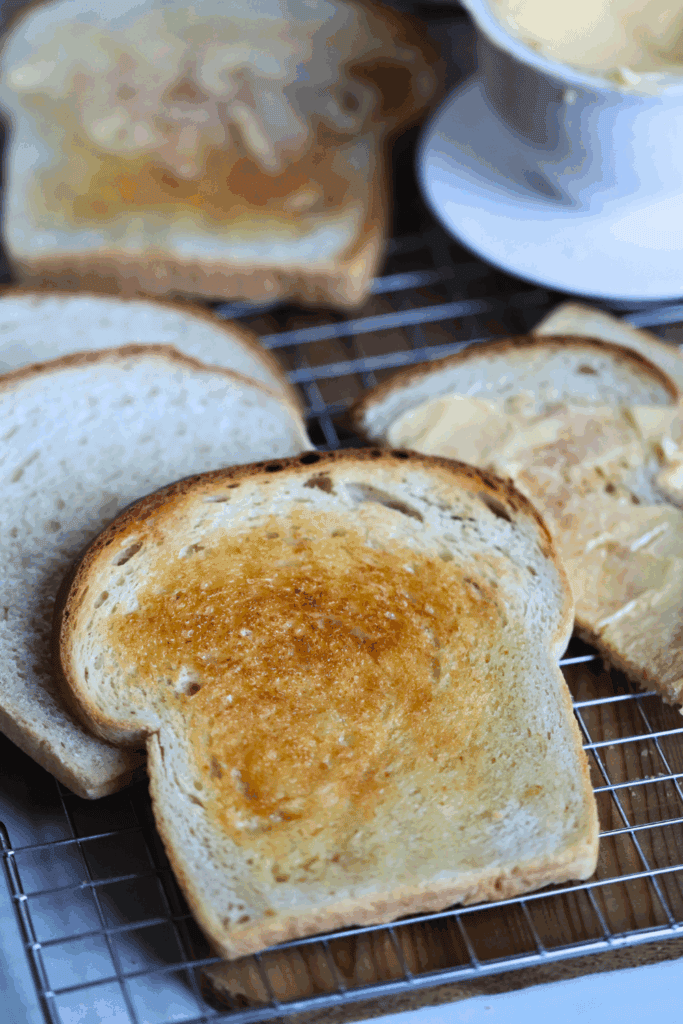
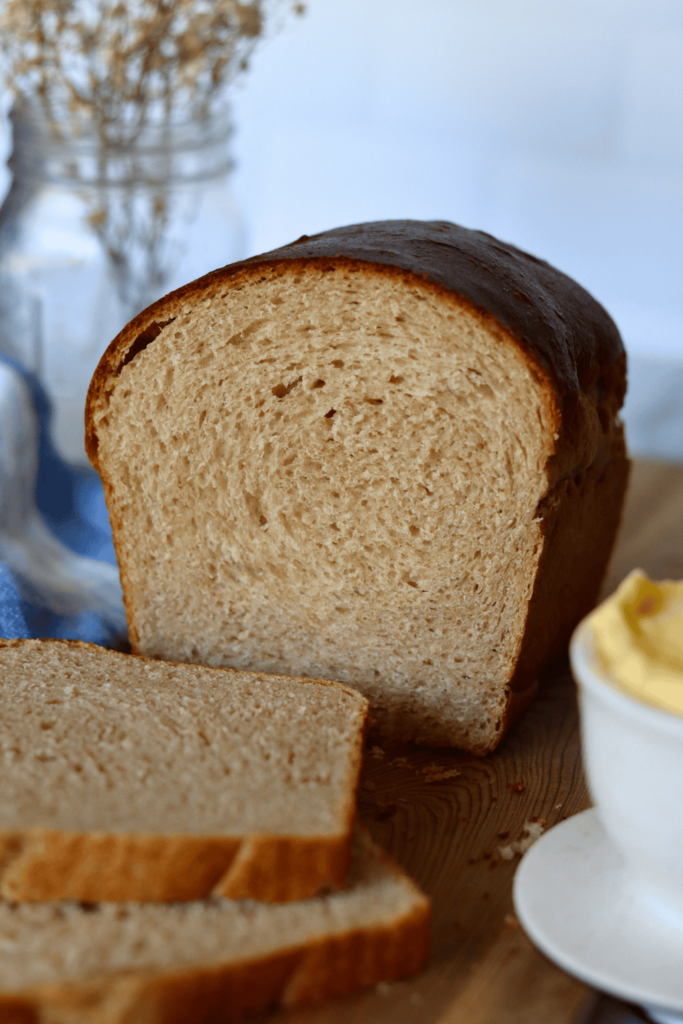
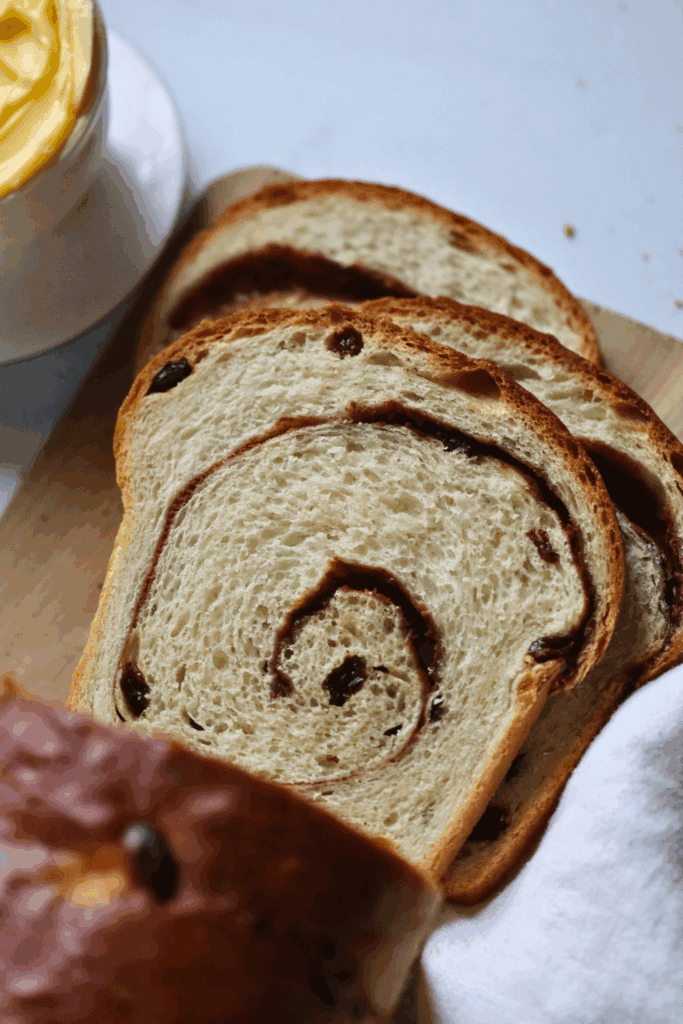

If you tried this Sourdough Sandwich Bread recipe or any other recipe on my blog, please leave a 🌟 star rating and let me know how it went in the📝 comments below. Thanks for visiting!
FULL RECIPE TUTORIAL
Sourdough Sandwich Bread Recipe
Enter your email below, and we’ll send it straight to your inbox! Plus, you’ll get my newest sourdough recipes and best tips every week!
Ingredients
- 65 grams active sourdough starter heaping 1/4 cup
- 300 grams warm water 1 1/3 cups
- 57 grams unsalted butter, melted 4 Tablespoons
- 25 grams white sugar 2 Tablespoons see notes*
- 400 grams bread flour 2 3/4 cups + 1 Tablespoon
- 100 grams all-purpose flour 3/4 cup
- 9 grams salt 1 1/2 teaspoons
Instructions
Make the Dough
- In a large mixing, whisk together the starter, warm water, melted butter, and sugar. The water and butter shouldn't be hotter than 110 degrees F, otherwise this can kill the starter. For the best results, use a kitchen scale and measure ingredients by grams.65 grams active sourdough starter, 300 grams warm water, 57 grams unsalted butter, melted, 25 grams white sugar
- Add the flour and salt to the wet ingredients and mix with a Danish dough whisk or your hand until all the flour has been incorporated. The bread dough will be shaggy and a little sticky.400 grams bread flour, 100 grams all-purpose flour, 9 grams salt
- Cover the bowl with plastic wrap or a reusable shower cap. Let the dough rest for 30 minutes to an hour to allow the gluten to relax a little bit.
Knead the Dough
- First, wet your fingers so the dough doesn't stick to them. Then, take a piece of the bread dough, pull it upwards, and fold it towards the center of the dough. Push the heel of your hand into the dough.
- Turn the bowl clockwise a quarter turn and repeat the same motion. Continue to knead the dough for about 20 seconds. The dough should become more stiff and smooth looking and feel tacky to the touch.
- Grease a straight edge mixing bowl with butter and place the dough with the seam side down.I love using this straight-edge bowl because it allows me to clearly see when the dough has doubled in size.
Bulk Fermentation
- Cover the bowl again and let the dough rise till doubled in size. In my kitchen at 70 degrees F, the bulk rise will takes anywhere from 8-10 hours. If your kitchen is warmer, it will take less time. Check often and look for signs that your dough is done, rather than the time. The dough will have doubled in size, be domed on top, remove easily from the bowl and if you are using a glass bowl, you'll see bubbles all throughout the bottom of the dough.
Shape the Dough
- Once the dough has doubled in size, remove the cover and punch the dough. Do so by placing your fist in the center of the dough and pushing it downwards. Punching the dough helps to release all the air bubbles.
- Remove and stretch the bread dough into a large rectangle on your work surface, then roll the bread dough into a log, like you would a cinnamon roll. Curl the ends of the sourdough sandwich bread under itself and pinch the seams together.
Second Rise
- Using a bench scraper, gently lift the sourdough bread dough and place it into a greased 8.5 x 4.5 inch loaf pan with the seam side down.
- Cover the dough for the final rise. In my 70 degree F kitchen, this will typically take 3-4 hours. To speed this step, I like to place the dough in my proofing box at 90 degrees F or in an OFF oven with just the light on. This creates a toasty environment for the dough to rise quickly, about 1-2 hours. Don't rush this step, allow the dough to rise until it is 1″ above the rim of the pan. Otherwise, the loaf will bake up dense and gummy.
Bake
- Preheat your oven to 375 degrees F.
- Place the loaf pan in the hot oven on the middle rack and bake for 40-45 mins, or until golden brown on top and the internal is 190-200 degrees F. If you notice that the top is browning too much before the loaf has finished baking, place a piece of aluminum foil on top of the loaf. for the rest of the baking time.
- Keep the loaf in the tin pan for an extra 5 minutes before removing it to cool on a wire rack.
- While the loaf is still warm, spread butter all over the top of the bread for a super soft and shiny crust.
- Place the loaf on a cooling rack for at least one hour before slicing. Enjoy!
Notes
Recipe Tips
- To prevent the sourdough sandwich bread crust from tearing, I like to place a cast iron skillet or baking sheet on the oven rack below the bread with a cup of ice cubes. This creates extra steam in the oven while the bread bakes, which keeps the surface of the dough soft allowing the bread to expand and rise without tearing.
- Sourdough sandwich bread will stay fresh for 3-5 days when stored in a plastic bag.
- Sourdough sandwich bread freezes exceptionally well. Once the bread has cooled completely, slice and store the pieces in a gallon-sized ziplock bag. Place small pieces of parchment paper in between the slices so they don’t freeze together.

I’m going to make your recipe tomorrow as I’m waiting for my starter to double … I have to tell you that was probably the best step by step recipe video for sourdough I’ve ever watched. You have a nice voice , don’t talk too fast and very informative about the process. Excited to try this !!!
Thank you so much—what a kind and encouraging comment! I’m so glad the video was helpful and easy to follow—that’s exactly what I hope for. Best of luck with your bake! I hope you love the sandwich bread as much as I do. Let me know how it turns out!
I made your recipe today for the first time after discovering your website. Wow, it turned out great. Love the video I saw on uTube also. It will be my go to recipe. Can’t wait to try your orange rolls next.
Thank you so much for trying the recipe and for your kind words! I’m thrilled your bread turned out great and that you enjoyed the YouTube video. Orange rolls next—yum! I hope you love them just as much. Can’t wait to hear how they turn out!
I just stumbled upon this recipe last week- it’s the recipe I’ve been looking for! It’s easy, forgiving and tastes incredible! The best rise I’ve ever gotten on sandwich bread and my family’s favorite- and I’ve tried several recipes! I double the recipe and have divided into three pans with success. Thank you!
So glad you enjoy this recipe, Sally! Thank you for sharing.
I’ve been trying out a bunch of different sourdough sandwich bread recipe and this is by far the best!!!!
So thrilled to hear you loved it, Emily! Thank you for sharing.
Can I refrigerated after shaping, before second rise? My timing was off.
Hi! This recipe was so easy to follow, but unfortunately the taste was a bit off ☹️. It might be because it’s my first time baking sourdough but it tasted almost like vinegar. What could this be due to?
Hi Laura! I’m so glad you thought the recipe was easy to follow. The vinegar taste is most likely from your sourdough starter! During the bulk fermentation, your sourdough starter will produce lactic acid, which gives sourdough recipes their signature tangy flavor. If you would prefer a more mild flavor, I would suggest placing your dough in a warmer spot to rise. This will make your dough rise faster, which will give you a less tangy flavor. Hope this helps!
Hi
Very fluffy soft bread we got following your recipe.
Thanks a lot
May I know how to reduce the sour taste in the bread.
I could feel the sour taste very well.
Thanks
Hi Um! I’m so glad you enjoyed this recipe! For a more mild tangy flavor, you will want to keep the dough in a nice and toasty spot (80-85 degrees F preferably). This will speed along the bulk fermentation (so check on your dough often!), which will give you a less tangy flavor. Hope this helps!
Hi! I made the mistake of not understanding how long it takes to make sourdough. This is my first loaf ever! I’m at the bulk fermentation stage, but it’s 3:00pm and by the time the 10 hr mark hits it will be 1:00 am 🤦🏼♀️ Can I put it in the fridge for a slower rise?
Hi Sami! You can certainly pop the dough in the fridge to slow down the fermentation. I hope it turned out and you loved it!
So easy and so fluffy! Thanks for a great recipe! Swapped the sugar for honey and proofed in the oven at 27°C all day. Went fast up to 93°C in the oven so only baked for 35 min or so. Turned out amazing!
So glad you love this recipe as well!
Hey! What causes a very thin gummy line at bottom? The whole loaf looks wonderful and fluffy except for this thin line at the bottom…under fermented or needs a lil longer in the oven?
Hi Kit! A thin gummy line is typically a sign of a proofing issue. This can happen when the dough was either under or over proofed. I’ve had this happen before and it’s still delicious!
If you follow your same day schedule of making the dough at 9am, when do you feed your starter prior to that? Does it seem to work if you just feed in the night before?
Hi Kayla! I feed my starter a 1:4:4 ratio (ex. 10g starter, 40g water, 40g flour) the night before and in my 69 degree kitchen, my starter is ready to use the following morning!
So how many hours for your starter to be ready?
The timing really depends on the activity of your starter, the ratio you feed your starter and the temperature of your kitchen. This usually takes anywhere from 4–8 hours at room temperature for a starter that’s been recently fed. For a 1:1:1 ratio (starter:flour:water by weight) sourdough starter,
Warmer kitchen (75–78°F / 24–26°C): The starter will double closer to 4 hours.
Cooler kitchen (65–69°F / 18–21°C): The starter may take 6–8 hours or even a bit longer to double.
I made this last night and planned for the first rise to be overnight but this morning the dough had not risen at all. Now it’s in the oven with the light on, and still doesn’t seem to be rising. What could be wrong? Do I ditch it? Or keep going?
Hi Megan, I’m so sorry to hear that your dough isn’t rising as expected. There could be a few reasons for this. If your kitchen is quite cold, it will take your dough much longer to rise. Sourdough likes to be toasty. Also, you don’t want to use water that is warmer than 120 degrees F. Anything warmer can kill your starter, which will prevent your dough from rising. Hope this helps!
Made for the first time today! It was absolutely delicious and easy enough to make! This will be a new staple in our house
Hi Brittany! I am so happy to hear that you enjoyed this recipe! We simply can’t get enough of it. Thank you for sharing!
This sandwich bread was really great! I was scared to try it at first because it had such a long schedule to follow, but I went for it. It actually ended up not taking as long as the schedule. And it was so soft and perfect as the final result. I made it twice (first a mix of bread flour and all purpose flour and then with only all purpose flour).
Could I make this recipe without the sugar?
Yes, but I recommend adding it! Sugar tenderizes the dough, keep it soft and fluffy, helps it bake to a golden brown and increases its shelf-life!